Monday, January 2, 2012

Half the Way Home: A Memoir of Father and Son by Adam Hochschild 1986

"Mr. Hochschild illuminates, with a rare tact, the situations of fathers and sons, and he avoids the traps of sentimentality and rancor both." From a review by Mary Gordon in the New York Times June 15, 1986

In this engaging memoir, journalist and writer Adam Hochschild (b. 1942) explores the relationship he had with his father, Harold Hochschild, who was the child of German Jewish immigrants. The author’s grandfather, Berthold, who came from a small village near Frankfurt, arrived in America in 1886 traveling first class, sent by his metal trading company to establish an affiliate in the states.

Hochschild writes that his grandfather spoke German and celebrated Christmas. He felt he had nothing in common with the masses of Yiddish-speaking Jewish immigrants from Eastern Europe and wanted nothing to do with them. His like-minded son Harold did what he could to suppress his Jewish origins. He married a socially prominent Protestant and moved from the Upper West Side enclave of German Jewish immigrants to Park Avenue on the East Side.

Hochschild’s father became the Director of his father’s company, by now a global metal trading company with interests in mines worldwide. A socially ambitious man, Harold Hochschild lived his life purposefully, acquiring all the trappings of success. The author, his only child, had a governess, he was chauffeured to private school, then went away to boarding school, and he traveled all over the world with his parents. Summer months were spent at Eagle Nest, a compound in the Adirondack mountains where the family, aided by a large assortment of cooks, maids, butlers, and groundsmen, entertained large groups constantly.

Harold Hochschild had expectations that his son, Adam, would follow in his footsteps, but Adam Hochschild resisted the pressure he felt his father always applied to keep him on the track he was expected to follow. Because of his father's expectations and because his father was emotionally repressed, he felt tense in his father's presence from as early as he can remember.

After his father’s death, in cleaning out his study, Hochschild came across a memo his father had written in 1940 when Hitler was marching across Europe that helped him to see that many of his father’s behaviors were reactions to his suppressed Jewish identity. His father's memo was about antisemitism and he wrote that Jews should conduct themselves so as to be not singled out as Jews;  they should not call attention to themselves. Harold Hochschild, the son of a successful German Jewish immigrant, did what he could to assimilate into the larger culture, convinced that this strategy was in the best interests of his family.

To read an interesting article about American Jews and assimilation, click here.

People
Berthold Hochschild
    Harold Hochschild – son of Berthold; married Mary Marquand
        Adam Hochschild – son of Harold and Mary; married to Arlie Russell; author
            David and Gabriel Hochschild – sons of Adam and Arlie
    Walter Hochschild – son of Berhold;
    Gertrude Hochschild – daughter of Berthold; married Boris Sergievsky
        Kira Sergievsky – daughter of Gertrude and Boris
Hannah Blumenthal – cousin (exact relationship unexplained)

Places
New York City
Germany
Eagle Nest, Adirondacks, NY
Princeton, NJ
San Fransisco, California

Monday, December 19, 2011

What They Saved: Pieces of a Jewish Past by Nancy K. Miller 2011

"Although Nancy Miller calls this book a memoir, it is in many ways more a family detective story, tracking a set of clues back into the past and across the globe. Or, perhaps better, it exemplifies how writing a memoir can move an author onto the openly shifting grounds of memory. . . ."  from a review by Joanne Jacobson in The Forward 9/20/2011

Nancy K. Miller (born 1941), scholar and Distinguished Professor of English and Comparative Literature at the Graduate Center of the City University of New York, has written a very useful memoir for those of us who are involved in genealogical research. This memoir is about the process of the search itself as well as the results.

Her mother’s large family – the Millers – were always a part of her life. Her father, Louis Kipnis, seemed not to have any close family. Because she was so disconnected from her Kipnis roots, and also because she was a committed feminist, she had elected, when she was younger, to relinquish a claim to the Kipnis name and adopted her mother’s Miller name as her last name. However, once both of Professor Miller’s parents died, she inherited the family archives – the letters, photos, and documents that had been stored in her parents’ dresser drawers. What she found concerning the Kipnis side of her family intrigued her: letters in Yiddish she needed to have translated, photos of presumed family members she could not identify, and documents that provided some answers but raised further questions.

She knew her father had had an older brother who had moved from New York to Arizona because his son had very bad asthma. She also knew she had never met her uncle and didn’t remember her father ever visiting him. Did anything happen that caused the brothers to be distant in ways that superseded geographical distance? Who were all these other relatives she had never met and why had she never even heard of them?

In trying to answer these questions she takes her readers on the same zigzag trail she ended up going on herself. She went straight ahead, became sidetracked, had to double back, got stalled, put the puzzle pieces aside, then started again after taking a fresh look. She met family members she never knew existed, consulted experts, hired researchers, and traveled to destinations all over the globe – to Tucson, Arizona, towns in the Ukraine, and to Israel - to follow clues.

During the course of the memoir she learned many important lessons which she passes on to her readers. For example, she learned that just because she was interested in uncovering her Kipnis roots, she couldn’t expect that others would be as interested or as enthusiastic or even cooperative. She learned that she often was working on erroneous assumptions. This involved a certain kind of tunnel vision that often impeded progress. And finally she learned that she had to come to terms with the fact that she couldn’t uncover every bit of information she was hoping to find, or that she expected to find. She had to concede that the wholeness of the past is finally irretrievable. Some questions would never be answered.

And she raises the important question about why she engaged in this quest at all. She devoted inordinate numbers of hours to the search which stretched over years, and she spent substantial sums of money on travel, on research, and on researchers. Although married, she has no children, neither does her one sibling, so there are no direct descendants to inherit or be enriched by what she uncovered. But she felt the need deep in her psyche – she craved a connection to her ancestors that was precipitated when she opened the dresser drawer. Perhaps, she suggests, it’s the preoccupation of an older person whose future is limited but whose past stretches back generations. She can now link her life to theirs.

To read an interview with Nancy Miller about her memoir, click here.
For more information on the Kishinev progroms, click here.

This memoir includes an extensive family tree, most of it reproduced in list form below. 

People
Author’s paternal grandfather’s side of the family
Harry Kipnis
    Moishe Mordecai Kipnis – son of Harry; married Zirel
        Raphael Kipnis – son of Moishe and Zirel; married Deborah (Dora) Cohen
            Chaim (Harry) Kipnis – son of Raphael and Deborah; married Sore (Sarah) Peak
                Raphael Kipnis – son of Chaim and Sore; married Sheindel (Sadie) Scholnick
                    Samuel Kipnis – son of Raphael and Sheindel; married Rose Epstein
                        Julian Kipnis – son of Samuel and Rose; married Billie Ruth
                            Sarah Kipnis – daughter of Julian and Billie Ruth; married Tillman Castleberry
                                Shannon Castleberry – daughter of Sarah and Tillman; married Joseph Davenport
                                Kelly Castleberry – son of Sarah and Tillman; married Stephanie Ware
                                    Kellan and Caiden Castleberry – children of Kelly and Stephanie
                    Louis Kipnis –  son of Raphael and Sheindel; married Mollie Miller
                        Nancy Kipnis (Miller) – daughter of Louis and Mollie; married Sandy Petry (author)
                        Ronna Kipnis – daughter of Louis and Mollie
                Zirl (Beckie) Kipnis – daughter of Chaim and Sore; married Louis Jacknis
                                        Rose Kipnis Jacobson – daughter of Zirl and Louis
                    William Kipnis – son of Zirl and Louis
                Itzock (Isidore) Kipnis – son of Chaim and Sore; married Beatrice Gordon
                    Frank Kipnis – son of Itzock and Beatrice; married Dorothy Sokol
        Israel Kipnis – son of Moishe and Zirel; married Esther   
            Abraham (Berel) Kipnis – son of Israel and Esther; married Sarah Greenstein; second marriage to Sarah Maidonick
                Feige and Sadie Kipnis – daughters of Abraham and Sarah           

Author’s paternal grandmother’s side of the family
Judah Scholnick – married Sarah Spack
    Shaindel (Sadie) Scholnick – daughter of Judah and Sarah; married Rafael Kipnis (see above)
    Sarah Scholnick – daughter of Judah and Sarah
        Gert Scholnick –daughter of Sarah; married Joseph Elieson
            Sarah Ann Elieson – daughter of Gert and Joseph
            Samuel Elieson – son of Gert and Joseph; married Nina
        Fredi Scholnick  – daughter of Sarah; married Tom Goldbloom
            Sam and Nathan Goldbloom – sons of Fredi and Tom
    Dvorah Scholnick Weisman – daughter of Juda and Sarah
        Etyushele Weisman – daughter of Dvorah

Author’s maternal grandfather’s side of the family
Willie Miller
    David Miller – son of Willie
    Abraham Miller – son of Willie
    Fay Miller – daughter of Willie
    Mollie Miller – daughter of Willie; married Louis Kipnis
        Nancy – daughter of Mollie and Louis (author; see above)

Family of author’s uncle Sam Kipnis’ wife Rose Epstein
Rachel (Ray) Epstein – Rose’s sister; married to Jack Ellison
    Brownie Ellison – daughter of Rachel and Jack; married to Joseph Ebner
        Michael Ebner – son of Brownie and Joseph
        Sarah Ebner – daughter of Brownie and Joseph; married to Bernard Frieden
            Miriam Frieden – daughter of Sarah and Bernard

Friends and Acquaintances
David R. Zaslowsky
David Linetsky
Max Meyerson
Fima Ephraim Rabinovitch
Yitzhaq Feller
Samuel Traub
Olga Sivac

Places
DeWitt Clinton High School, NYC
Talmud Torah Anshe Zitomir, NYCZitomir Talmud Torah Darchei Noam, NYC        
New York City, NY
Kishinev, formerly capital of Bessarabia, now Moldova
Bratslav, Ukraine
Peschanka, Ukraine
Podolsk, Ukraine
Pechora (Dead Loop), Ukraine
Tulchin, Ukraine
Ein Hemed, Jerusalem, Israel

Monday, December 5, 2011

The Mirador: Dreamed Memories of Irene Nemirovsky by Her Daughter by Elisabeth Gille, published in French in 1992; published in English in 2011 (a novel)

"Although, of course, 'The Mirador' carries with it all the emotional weight of a daughter’s grieving monument to her mother, it also makes no effort to accuse or to apologize for Némirovsky’s fraught relationship with her Jewishness, a subject of which Gille is not only aware but one that she bravely confronts head-on." from a review by James K. McAuley in the Harvard Crimson, 11/15/2011
 
The Mirador, written by the younger of the writer Irene Nemerovsky’s two daughters, is an intriguing and largely successful literary experiment. Elisabeth Gille, who was five when her mother was deported, has written a fictional memoir. She has imagined her mother’s voice and has her mother tell her story, starting from her mother’s childhood in Russia up until she is seized by the Nazis from where she is living in a small town in France.

This fictional memoir is divided into two parts: In Part I the imagined voice of Nemerovsky narrates her privileged life growing up in Russia. Gille, who was born in France in 1937, conducted extensive research. She is wonderful at bringing to life the heady days of pre-Revolutionary Russia enjoyed by the elite which included her mother’s family. She paints pictures of engrossing cultural and political scenes, detailing how the Nemerovskys spent their time entertaining and being entertained. But times became difficult for Russian Jews; anti-Semitism lurked right below the surface and when there was any kind of economic pressure and political unrest, the lives of all Jews were restricted and they were often the victims of violence. Anticipating the difficulties for his family during the upheavals created both by World War I and the Russian Revolution, Nemerovsky’s very wealthy banker father managed to move his assets to Stockholm and smuggle his wife and daughter to France with their jewels sewed into the linings of their clothes.

Part II, which takes place in France where the family arrived in 1919 when Nemerovsky was 16, starts with Nemerovsky’s education, and moves on to her gradual triumphs as a writer, her marriage to Michel Epstein- a fellow émigré from Russia who had the means to maintain the very comfortable lifestyle Nemerovsky was accustomed to - and the birth of their two daughters. In the 1930’s as Hitler’s threats increased, Nemerovsky saw no reason to leave France. She considered herself French, never having identified as a Jew. And felt well-placed amongst the intellectual elite.She felt no connection to the poor foreign Jews flooding into France from Easter Europe.  But gradually she was forced to acknowledge the threat of Hitler’s reign in neighboring Germany. Gille gives an interesting and useful historical overview of encroaching Nazism in France, and she shows how Nemerovsky finally saw herself being hemmed in more and more by the government’s pronouncements against Jews. In July of 1942, in the midst of writing the novel Suite Francaise (which was finally published posthumously in its unfinished state in French in 2004 and  in English in 2006), the Nazis seized Nemerovsky and she died in Auschwitz at the age of 39.

Gille’s experiment of creating her mother’s voice and re-creating her life gave Gille the opportunity to get to know the mother she never really knew. She gleaned information from all of her mother’s writing, conducted interviews, and consulted historical sources in order to re-create her mother and her family as well as her life in Russia in the first two decades of the twentieth century and in France in the next two decades. 

Gille creates a layered structure that works to intensify the tragic outcome. Each chapter starts with a page that contains a date followed by a paragraph in italics. These preliminary paragraphs are about the author – Elisabeth Gille. The first is about her birth, and each subsequent paragraph at the beginning of each chapter details a moment in her life that take the reader right up to 1991. These paragraphs act both as a parallel condensed memoir and as commentary on the larger story of her relationship to her mother and her mother’s premature death.

Although it reads like a memoir, we must think of this as a novel. We cannot assume that every scene, every characterization, is exactly as Irene Nemerovsky herself would have rendered it. It’s impossible for a reader to sort out fact from fiction. But it seems that Gille was aiming for accuracy – she was trying to explain her mother to herself and to a larger audience. In forcefully recreating her mother's short life, she ably depicts a personal and public tragedy.

This English translation published by the New York Review of Book also includes an Afterword by Rene de Ceccatty in which he discusses, amongst other topics, the challenges Gille took on in writing in her mother's voice. It also includes an interview de Ceccatty conducted with Gille.

To learn more about Irene Nemerovsky, her writing and her family, as well as to see photos, click here.

People
Irene Nemerovsky’s father’s family
Boris Nemerovsky – married Eudoxia Korsounsky
    Leon Borosovich Nemerovsky – married to Fannie
        Irene Nemerovsky - daughter of Leon and Fannie; married Michel Epstein; author
            Denise Nemerovsky-Dauple – daughter of Irene and Michel
            Elisabeth Epstein Gille – daughter of Irene and Michel

Irene Nemerovsky’s mother’s family
    Jonas Margoulis – married Bella Chtchedrovitch
        Assia Margoulis – daughter of Jonas and Bella
        Fannie - daughter of Jonas and Bella; married Leon Borosovich
            Irene Borosovich – daughter of Leon; marries Michel Epstein (see above); author

Irene Nemerovsky’s husband’s family
Efim Epstein
    Samuel Epstein – son of Efim;  married to Alexandria Ginzbourg
        Natasha Epstein– daughter of Samuel and Alexandria
    Paul Epstein – son of Efim
    Sophie (Mavlik) Epstein – daughter of Efim
        Victor ? – son of Sophie
    Michel Epstein – married to Irene Nemerovsky (author)
Rhaissa Epstein – sister of Effim Epstein; married Alfred Adler

Friends
Boris Kamenka
    Daria Kamenka – daughter of Boris
    Hippolyte – son of Boris
Mila Gordon
Helene Gordon – sister of Mila; married to Pierre Lazareff   
Harry Baur
Daniel Halevy
Emmanuel Berl
Tristan Bernard   
       
Places
Kiev, Ukraine
    Podol neighborhood of Kiev
Odessa, Russia   
    Moldavanka ghetto, Kiev
Moscow, Russia
St. Petersburg (Petrograd), Russia
Paris, France
Issy-L’Eveque, France
Auschwitz, Poland

Monday, November 21, 2011

The Arrogant Years: One Girl’s Search for Her Lost Youth, from Cairo to Brooklyn By Lucette Lagnado 2011

"'The Arrogant Years' . . .  [is] a paragon of memoir writing, a story about the complex swirl of people and events and forces out of which individual lives are made — some, like Ms. Lagnado’s, more painfully, but also more fully, than others." from a review by Alana Newhouse  in the New York Times 9/8/2011

This sequel to Lagnado’s first memoir, “The Man in the White Sharkskin Suit,” follows the same trajectory as the first – the memoir starts in Cairo where the Legnados lived as members of a large, prosperous Jewish community before they immigrated to Brooklyn, New York. But this second memoir shines the spotlight on different family members. This time around Lagnado spends very little time on her father who was the subject of her first memoir. Instead, she focuses on both her mother’s life and her own. 

She starts by recounting what she has learned about her mother’s childhood, describing in detail her mother’s mother and the life and culture of Jewish women in the Levant. She relates how her mother, highly educated with a satisfying career, felt obligated to give it up when she married. The marriage was problematic from the start. The author’s father felt free to do what he wanted whenever he wanted to; her mother became a passive, depressed housewife and mother.

Once Nasser came into power most members of the Jewish community fled, many going to Israel and the United States.  Lagnado’s father resisted leaving until conditions were just about impossible and they  immigrated in 1963 when the author was 7,  settling in Bensonhurst in Brooklyn, New York amongst other Jewish immigrants from the Levant.

In subsequent chapters the author elaborates on growing up in Brooklyn in the midst of a socially conservative, insular, transplanted immigrant Jewish community from the Levant where the cultural ties to their home countries were strong. Like in many immigrant groups, parents tried to keep the old ways, replicating customs they grew up with, including founding both religious and educational institutions that were designed to mirror those they left behind. Lagnado notes that some children stayed close to their parents, happy to abide by their wishes, choosing mates from within the community and settling close by. But in some families, like in her own, there was an ongoing tension between conducting their lives the way they had in the past versus embracing American customs and values.

Her father, partly because of a fall and botched surgery in Cairo, never attained the stature he had in Cairo, and sat by, a tired old man, while his family defied him. His children went to American schools and colleges, and his wife decided to go back to work. But although the author’s mother enjoyed her work at the Brooklyn Public Library, it was clear that the cultural shift was difficult and wearing on her. Especially upsetting was that Suzette, their oldest daughter, although still unmarried, moved away shortly after they arrived in America never to live with them again.

The author was very close to her mother who allowed her some freedom, but not enough. She would not let her mother's and the community’s old-world values stand in the way of what she wanted - the chance to embrace America, and to take advantage of what it had to offer. She succeeds in this struggle, becoming a well-established journalist and writer, but toward the end of the memoir she looks back. She revisited old friends from the community now dispersed, some living in Israel. She found many of them living lives very similar to the lives they led when they were growing up in Bensonhurst. While she cannot imagine living the lives they lead, she envies their feeling rooted in their traditions and clear-headed about the choices they made. She feels especially sorry about the tragedy of her mother's life: being caught between two worlds, not comfortable in either one.

To read the post in this blog reviewing Lagnado's The Man in the White Sharkskin Suit, click here.

To read an article about the displacement of Jews from Arab countries, click here.

People
Family
Descendants of father’s side of Laniado rabbinic dynasty of Aleppo, Syria
    Shlomo Laniado – rabbi in 17th century

Leon Lagnado - married Edith Lagnado
    Suzette Lagnado – daughter of Leon and Edith
        Sasha – son of Suzette
    Cesar Lagnado – son of Leon and Edith; married Monica
        Carolyn and Evelyn Lagnado – daughters of Caesar and Monica
    Isaac Lagnado – son of Leon and Edith
    Lucette Lagnado – daughter of  and Edith; married Douglas Feiden

Maternal family
Selim Dana – married Rachel Dana (his niece)
    Alexandra Dana – daughter of Selim and Rachel married Isaac Matalon
        Edith Matalon – daughter of Alexandra and Isaac; married Leon Lagnado (see above)
        Felix Matalon – son of Alexandra and Isaac
Edgar Dana – Alexandra’s brother; married Marie
    Rachel Dana – daughter of Edgar and Marie
Farida – half-sister of Alexandria
Rosee – half-sister of Alexandra
    Lily – daughter of Rosee
Edouard  – half-brother of Alexandra
Lily Halawani – cousin of mother (daughter of Rosee, above?) exact relationship not clear

Salomone Silvera – relative, relationship to side of family unclear; married Sally
    Davide Silvera – son of Salomone and Sally
Rachel and Pico Hakim – relatives, relationship to side of family unclear
    Rosette Hakim – daughter of Rachel and Pico


Friends, Acquaintances and Members of the Jewish Community Past and Present
In U.S.A.
Rabbi Harry Rubin
    Miriam, Deborah, Rebecca, Rochelle and David Rubin – children of Harry
Abraham and Adele Cohen
    Leah, Gracie, Esther, Margarita Cohen - daughters of Abraham and Adele
    Rebecca Cohen Choueka – daughter of Abraham and Adele; married Eric Choueka
Rita Douek
Karen Alter
Marlene and Avi Ben Dayan
Celia Garzon Weinstein - Moshe Garzon's sister
Moshe Garzon – Celia Garzon Weinstein's brother
Joseph Hannon
Sarah Menachem
Rabbi Baruch Ben Haim
Rabbi Saul Kassin
Lillian Mosseri
Carin Roth
Eugene Gold
    Wendy – daughter of Eugene
Henry Finkelstein
Cyrus Wolf
    Laurie Wolf Bryk– daughter of Cyrus; married to Eli Bryk
        Lanie and Jackie – daughters of Laurie
    Trudy Wolf – daughter of Cyrus
Dr. Sydney Diamond
Rabbi Sam Horowitz
Fortune Cohen
Gladys – sister of Fortune; married Saul
Rabbi Rafael Benchimol
Kim Amzallag
Leah Iny
Stella Issever

In Egypt (or roots in Egypt)
Alice Suarez – married Yussef Cattaui
    Indjii, Aslan, and Rene,  – children of Alice and Yussef
        Nimet Cattaui – granddaughter of Alice and Yussef
            Michel Alexane – son of Nimet
        Stephane Cattaui – grandson of Alice and Yussef; married Maria Livanos
        Indjy Cattaui-Dumon – granddaughter of Alice and Yussef
    George Cattaui – nephew of Yussef
                Florence Sutter – gggranddaughter of Alice and Yussef (exact relationship unclear)
Moise Cattaui
Odette Harari
    David Harari – son of Odette
Yussef “Sousou” Makar
Sarah Naggar Halawani
Desi Sakkal
Ninette Toussoun
Rabbi Haim Nahum
Dr. Baroukh Kodsi
Maggie Wahba
Carmen Weinstein
Victor, George, and Haim Haboucha

Places
 Egypt
    Cairo
        neighborhoods: Garden City, Sakakini, Haret-el-Yahood, Heliopolis, Zamelek, Maadi, Fustat
        L’Ecole Cattui – Sakakini
        Le Sebil Jewish school
        Cicurel Department store
        Orozdi-Back Department store
        Shepheard Hotel
        L’Hopital Israelite
        Groppi’s
        Temple Hanan
        Ben Ezra Synagogue
        Gazira Sporting Club
        Villa Cattaui
    Alexandria
        Neighborhoods: Sporting, San Sefano, Sidi Bishr
        Delices
    Ras el-Bar, Egypt
        Aslan Hotel

USA
    Brooklyn, New York
        Neighborhoods: Bensonhurst, Brighton Beach, Park Slope, Ocean Parkway
        Shield of Young David Synagogue (David Magen)
        Ahaba ve Ahava synagogue
        House of Jacob Academy (Beis Ya’akov)
        Berkeley Institute
    Five Towns, Long Island, NY –areas: North Woodmere, Hewlett Harbor
    Gates of Prayer Synagogue, Manhattan
    Fifth Avenue Synagogue, Manhattan
    Deal, New Jersey

Monday, November 7, 2011

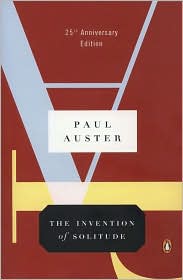
The Invention of Solitude by Paul Auster 1982


"'What really struck me was the purity of his tone. As a publisher, you're always looking for tone and he had that in blinding amounts, a faintly detached, very cerebral tone,' [Robert] McCrum says." Quoted in an interview with Hadley Freeman published in The Guardian on 10/25/2002

The writer Paul Auster’s two-part memoir deals in the first half with his relationship with his father. The second part is more a philosophical meditation and intellectual inquiry into the author’s role as both father and as grandson.  It also deals with the interplay between memory, the role of language in apprehending memories and the nature of solitude. 

The first section of Auster’s memoir, called “Portrait of an Invisible Man,” is about his father’s absence when he was growing up. Samuel Auster, who was born in around 1911, worked long hours, leaving the house before his two children awoke and returning home after they were asleep. But more to the point, even when the author spent time with him on the weekends and holidays, he was remote and emotionally unavailable. Auster recounts vivid examples of how his father failed him, puzzling over his father’s behavior, longing for a way to reach him.

When he was adult, the frustration of having such an unsatisfactory relationship with his father drove him to learn more about him. Eventually the author was able to piece together a narrative from several sources that revealed his father’s very difficult childhood, which included a rather nomadic existence. His grandparents, Jewish immigrants from Austria, started a business in Lawrence, Kansas that failed. Eventually they settled for a while in Kanosha, Wisconsin where his father, the youngest of five, was raised during his early years. When the author was already an adult an old man from Kanosha who happened to sit next to his cousin on a plane, told a horrifying story about the Austers and  directed her to newspaper articles from 1919  in the Kenosha Evening News for details.

What he learns about his father’s upbringing may help him intellectually to better understand his father’s remoteness, but does not wipe away the longing he had for a meaningful relationship. The poetic intensity of Auster’s prose heightens the effect, leaving the reader with a powerful image of a relationship that was never whole.

Although family relationships have a place in the second half of the memoir, “The Book of Memory” is a more extended meditation on life, on life cut short, on presence and absence, on the function of memory. The author writes about his own absence in his son’s life once he and his wife divorced, and also about his caring for his dying maternal grandfather which of course triggers vivid memories of their life together. Auster’s style of writing in this section is not typical of a memoir. It is both intimate and ruminative. He probes and poses difficult questions.

To watch an interview with Paul Auster discussing his writing, click here. 

People
Family
Samuel Auster – brother of Harry Auster; author’s great-uncle
Harry Auster – brother of Samuel Auster; married Anna; author’s paternal grandparents
    Samuel Auster – son of Harry and Anna; married Queenie
        Paul Auster – son of Samuel and Queenie; author
            Daniel Auster - son of Paul Auster
Elizabeth Grossman - Anna Auster's sister

Friends and Acquaintances
Fanny Koplan
Rabbi M. Hartman
Gregory Altschuller

Places
Lawrence, Kansas
Kenosha, Wisconsin
Chicago, Illinois
Weequahic section of  Newark, New Jersey
New York City, New York


.

Monday, October 17, 2011

Life With a Star by Jiri Weil published in Czech in 1949, published in English in 1989 (a novel); introduction written by Philip Roth

"[Josef Roubicek's] story stands as one of the most powerful works to emerge from the Holocaust; it is a fierce and necessary work of art." from a review in the New York Times by Michiko Kakutani on 6/9/1989

Jiri Weil (1900-1959) was a Jewish Czech writer who lived in Prague, and, according to Philip Roth’s lauditory introduction to this novel, lived a life in some ways similar to his main character Josef Roubicek. When the Nazis came to deport Weil he disappeared with the help of the resistance.

In the novel, which takes place in Prague, Roubicek at the time of the Nazi occupation is a young man who had been a bank clerk, but because of the restrictions placed on employing Jews, he has lost his job and lives starving in a garret where he’s burned most of his furnishings to keep himself warm.

Weil recreates an absurd and cruel world which takes on a surreal quality governed by Roubicek’s terror. The prose is spare and matter-of-fact, which has the effect of highlighting the horror. Roubicek knows he has been condemned even though he is innocent,  and we watch with mounting tension as he obsesses about what will happen to him next. When will his destroyers finally close in? When will he be selected to be deported?

Weil is also very adept at recreating the "Community," the part of the nightmare version of everyday life when Jew turned against Jew.The group of Jews in Prague who the Nazis designated as a governing body to enforce Nazi rules and regulations  are a terrifying presence. Roubicek lives in dread of  a message from them or a knock on the door.

Weil convincingly plumbs the psyche of his main character, his alter-ego. He also recreates the streets and neighborhoods of Prague filled with officials, as well as Roubicek's friends, acquaintances and many fellow sufferers. All of these various threads contribute to the novel's texture of reality.

People
Jiri Weil - author


Places
Prague. Czechoslovakia
Stresovice neighborhood of Prague

To read an article about the History of the Jews in Prague, click here.

Monday, October 3, 2011

Shlemiel Crooks by Anna Olswanger, illustrated by Paula Goodman Koz 2005

"The best thing here ... is Olswanger's Yiddish storyteller's voice, particularly the hilarious curses she weaves into the story ... Great for reading aloud." Reviewed by Hazel Rochman in Booklist

 A recent very entertaining children’s book awarded the designation of Sydney Taylor Honor Book is Anna Olswanger’s Shlemiel Crooks, colorfully illustrated by Paula Goodman Koz. Olswanger’s story which takes place in the first decade of the 20th  century is about Jewish immigrants in St. Louis. Why St. Louis?  Anna Olswanger based her children’s story on real events; she is recreating and joyfully embellishing an incident in the life of her great-grandfather when his saloon was nearly robbed.

In a short postscript in her book she tells the reader  that she only learned of the names of her great-grandparents, Elias and Dora Olschwanger, when, in 1982, she “started to research her family tree” which took her to St. Louis where they had lived. Part of the results of that research are two documents from the St. Louis Jewish Record that she reproduces at the end of her book in their original Yiddish along with English translations.

The first document is an ad placed by Olswanger’s great grandfather in February of 1918: It reads in part: “Eliyahu Olschwanger wishes to make known to all his friends that he has a fine and large stock of full and half-bottles of Carmel wines and cognacs. He has also purchased a large stock of Manischewitz from Cincinnati,…slivovitz, and … pesach’dik mead… Come in and order in time before the rush…” His name, address and phone number follow.

The second article reproduced was published a year later in 1919 (in Yiddish) under the heading “Reb Eliyahu Olschwanger Almost Robbed.”

“Shlimazel crooks, their work was unsuccessful. Last Thursday at 3:00 a.m. in the middle of the night, several men drove to the saloon of Reb Eliyahu Olschwanger at the corner of 14th and Carr streets. They opened the saloon and removed several barrels of brandy and beer. Mr. Mankel who lives on the second floor, upon hearing what was going on in the saloon, opened the window and began shouting for help. Benjamin Resnik from 1329 Carr Street, hearing the shouting, shot his revolver from his window. The band of crooks got scared and left everything, including their own horse and wagon and ran away. Police immediately came and took everything to the police station.”

 Out of these details and her imagination Olswanger has created a vibrant children’s book. The narrator tells this story in an animated “Guess what happened - Reb Olschwanger was almost robbed” tone of voice which pulls us right in. The story is dotted with Yiddish words, for example, “Such a tummel they were making!” And enhancing the animated narration are the colorful drawings by Paula Goddman Koz, many of them full-page. We see tenements where the wash is strung out across buildings. Another is a re-creation of what the storefront of Reb Olschwanger’s saloon might have looked like with men, women, boys and girls in period clothing, and another is of men studying Talmud.

The documents would, of course, thrill a family researcher. They are “only” a business advertisement and a report of an “almost” robbery but there is significant information to be gleaned. Reading these documents Anna Olswanger would have learned what her great-grandfather did for a living, that he was an enterprising business man serving his community and that he most probably spoke Yiddish. She would have found out his home address and his business address and phone number and of course she would have noticed that he spelled his name differently from the way she spells hers. She also would have learned the names and addresses of several of his neighbors which seems to indicate that he lived in a Jewish neighborhood.

Anna Olswanger has honored her great-grandfather by writing a children’s book based on an incident from his life which helps us to experience aspects of early immigrant life in America. Paula Goodman Koz's illustrations contribute a great deal to our experience.

To learn more about the genesis of this book and more about the Olschwanger family, click here.

People
Elias (Eliyahu)and Dora Olschwanger - author's paternal great-grandparents
          Anna Olswanger - author
Benjamin Resnik - neighbor   
Paula Good Koz - illustrator

Place
St. Louis, Missouri

Monday, September 19, 2011

The Neppi Modona Diaries: Reading Jewish Survival through My Italian Family by Kate Cohen 1997

 "The voices of the Neppi Modona family are interwoven with their discussions with the author. The frequent shift of focus enlightens rather than obscures. Four stories that remind us of the human dimension of history." from a review from Kirkus Reviews 11/1/96


Kate Cohen wrote this book with the financial help for foreign study from the Dartmouth College Committee on Graduate Fellowships. The award financed a trip to Italy so that Cohen could interview relatives of her father - Rachel Neppi Modona and her daughter Lionella, the two surviving members of their immediate family of four. The entire family had survived World War II, but Rachel’s husband Aldo and their son Leo, both of whom had kept diaries during the war years, died before the author began working on this book.

Having access to the two diaries and being able to interview the surviving women gave the author a window into how the family and many of their fellow Jews survived during World War II, first under Mussolini and then Hitler. The memoir is divided into four sections. In a general introduction we meet these Italian family members and learn some of their history. The next two sections consist of excerpts from the two diaries, first Leo’s rather short one, then his father’s longer diary. Throughout both sections Cohen intersperses diary entries with conversations she had with both Rachel Neppi Modona and her daughter Lionella who clarify and expand upon some of the circumstances discussed in the diaries. In the fourth section the author contextualizes their World War II experience and discusses the effects of the trauma of uncertainty, fleeing and hiding had on family members during the war and in post-war Italy. 

Some of what we learn from reading this memoir is that the Neppi Modona family whose home city was Florence was financially well off, well educated, and part of a large social circle. Aldo Neppi Modona’s family had lived in Italy for many generations and he was not at all an assimilated Jew. He was traditionally Orthodox and his religion and observance were very important to him. He was a fervent Italian patriot who had served in World War I and, in fact, was a member of the Fascist party. He could not believe that he would become a pariah. Little by little his status was eroded. Eventually he lost his teaching position, had to leave his home, and with his family wandered from one town to the next boarding with relatives, friends, and friends of friends in order to evade detection.

In reading the excerpts from these diaries, the discussions with the survivors, and the author’s commentary, we learn about the specific situation of the Neppi Modonas during World War II as well as the situation of Italian Jews in general. The author ends by explaining how reading the diaries and conducting the interviews helped her to gain insights into her own upbringing as a post-war Jewish American.

To read an article in the New York Times about recent research that deals with Jews in Italy during World War II, click here.

People
Leone Neppi Modona – married to Ada
    Aldo Neppi Modona – son of Leone and Ada; married to Rachel Fintz
        Lionella Neppi Modona – daughter of Aldo and Rachel; married to Guiseppi Viterbo
            Ada Viterbo – daughter of Lionella and Guiseppi
                Tal – daughter of Ada
            Emanuele Viterbo – son of Lionella and Guiseppi; married to Lia
        Leo Neppi Modona – son of Aldo and Rachel

Carlos Alberto Viterbo – father of Guiseppi Viterbo (married to Lionella Neppi Modona)

Family relatives – exact relationships unstated
Valentina Neppi Modona
Leone Ambron – cousin of Aldo Neppi Modona
Bettino and Luisa Errera
Matilde Nissim
Ernesta Neppi Modona
Amalie Cohen
    Ralph Cohen – son of Amalie; married to Judy
        Kate Cohen – daughter of Ralph and Judy;  married to Adam Daniel Greenberg; author
        Amy Cohen – daughter of Ralph

Friends and Acquaintances
Alfonso Pacifici
Enzo Bonaventura
Alfredo Forti
Siebzehner family
Costanza Salmon
Segre family
Viterbo family
Riccardo Dallo Volta
    Enrico Dalla Volta – son of Riccardo
    Margherita Dalla Volta – daughter of Riccardo
D’Urbino sisters
Nathan Cassuto – married to Anna
    David Cassuto – son of Nathan
       

Places
Rhodes
Anghiari, Italy
Florence, Italy
Galluzzo, Italy
Rome, Italy
Patmos, Greece
Israel

Monday, September 5, 2011

We Are On Our Own: A Memoir by Miriam Katin 2006

"Even as fiction it would be one of the best stories I've read in the last year, but as a memoir it leaves you speechless." from a review by Andrew D. Arnold in Time magazine 6/1/06

Miriam Katin, born in 1942 in Hungary, is a graphic artist who has lived and worked in the United States and Israel. This graphic memoir tells the story of her and her mother’s flight from Budapest in 1944. They fled to the countryside where with forged papers her mother sought work disguised as a peasant and lived with the constant fear of being discovered as a Jew.

In 1968, Miriam Katin was herself a young mother and is remembering her own childhood during World War II. A number of times she interrupts the story of her childhood to present a scene of her interacting with her young child. The contrast between the two time periods and the two mother/child situations is stark, and one way aesthetically Katin makes this point is to draw the scenes from her childhood (which take up most of the book) in pencil with no color except for the bright red of the Nazi flag. The scenes of her and her child are colorful and drawn with more detail.

This book is called a memoir – it is not presented as fiction – but Katin has chosen not to use her and her mother’s real names. Although she provides no stated reason for this, it is most likely because, as she explains in an epilogue, she was only two at the time of their flight and has no independent memories. She is relying on the stories her mother told her whose details she cannot verify, but she can depend on her own emotional memory of fear and displacement. She illustrates though a number of contemporary scenes how the trauma of both her and her mother’s wartime experiences affected their postwar lives.

In an epilogue Katin reveals that she relied on information she found in letters her mother sent to her father when they were in hiding and he was a soldier at the front. On one page she makes a collage of several letters and a postcard her mother sent her father that reached him. On another she reproduces a photo of her and her mother taken in 1946.

To read a short article about the siege of Budapest in 1944 click here.


Places
Budapest, Hungary
New York City, NY
Israel