"Borne on the generational ripples of a painful history, Arnon Goldfinger's 'The Flat' is a true-life detective story that uncovers much more than the tangled roots of its maker's family tree."
from a review by Jeannette Catsoulis in the NY Times 10/18/2012
This documentary, primarily filmed at the flat of Arnon Goldfinger’s recently deceased widowed grandmother, focuses on issues having to do with the Holocaust that he and his family only start to confront when they start emptying her apartment.
Goldfinger’s grandparents were successful German Jews who lived in Berlin, but left for Israel before the war. As Goldfinger remarks, his grandmother, who died at the age of 98, lived her life in Israel as if she were still a citizen of Germany. She visited Germany yearly and held on to many possessions from Germany, including old newspapers, letters and photos.
Those artifacts from her past open up a world that the author did not know existed, nor did his mother, who had been born in Berlin. Goldfinger wants to understand what he has learned, so he travels to Germany to interview the German daughter of former friends of his grandparents. On a second trip he brings his mother along and they also visit a cousin who lives in Berlin who fills in more of the family picture.
The movie serves to demonstrate what is now a pretty well-established point: that those traumatized by the Holocaust often did not speak of it and that the children of the second generation most often respected those boundaries. Goldfinger himself is now puzzled as to why he and his siblings asked so few questions about his grandmother’s past.
What is very interesting are the conversations in Germany with the German daughter of his grandparents’ friends. Pressing her with information he has researched about her father, he finds she has maintained a willful ignorance of her father’s past. On both sides (although for different pschological reasons), Goldfinger found the trauma of the Holocaust buried. On both sides, a veneer of normalcy prevailed.
To read an interview with Arnon Goldfinger, click here.
To read an article about another German Jew who fled Germany and settled in Israel published in Haaretz, click here.
Family
Susanna and Heinich Lehmann
Gerda Lehmann – married Kurt Tuchler
Hannah Tuchler Goldfinger – daughter of Gerda and Kurt
Arnon Goldfinger –son of Hannah; writer/director
Noam Goldfinger – son of Hannah
Yair Goldfinger – son of Hannah
Gidi – of Hannah
Orit Goldfinger-Mendel – daughter of Hannah Goldfinger
Paula Lehmann Weinstein – sister of Heinich
Manuel Trokes – grandson of Paula Lehmann
Rani Eisenberg – cousin; exact relationship not clear
Places
Tel Aviv, Israel
Berlin, Germany
Monday, September 16, 2013
Monday, September 2, 2013
The Enemy at His Pleasure: A Journey Through the Jewish Pale of Settlement During World War I by S. Ansky edited and translated by Joachim Neugroschel, published in English in 2002
"Ansky balances his tale among statistics (of depleted populations, refugees and destroyed property, for instance), telegraphed stories told to him by survivors and his own experiences cast in an unflinching reportage." from a review in the Jewish Daily Forward by Alyssa Quint, 2/25/2005
In the Introduction to this compelling memoir, editor and translator Joachim Neugrsoschel writes that S. Ansky, born Shloyme Zanvel ben-Aaron Rappaport in Vitebsk, who is now best known for his play, The Dybbuk, was a Russian Jewish intellectual who became fascinated with ethnographic research. He used that interest to observe and record Jewish customs and folktales as he traveled throughout the Jewish Pale of Settlement. But he had to cut short his research when World War I broke out.
During the war he resumed travel, this time to aid Jewish communities who were adversely affected by the war. He became a driving force in alerting authorities, convening Jewish Welfare groups, requisitioning supplies, and requesting and doling out funds as he traveled back and forth between the countryside and Kiev and St. Petersburg. Ansky based this memoir on his notes from the field during the time he spent mostly in Galicia. He also reports on some locations he visited in Bukovina. He finished the memoir in 1920, the year he died.
Ansky felt deeply the tragic situation of the Jews, especially those in small shtetls with few resources. He notes that their outsider status, wherever they lived, made them vulnerable to all kinds of abuse, and it was easy for many different national and ethnic groups to scape-goat the Jews based on long-held anti-Semitism. In this case they were suspected by the Russians of aiding the Germans and Austrians, and at the same time, the Germans and Austrians suspected them of spying for the Russians. Advancing, occupying and retreating forces ravaged their businesses and set fire to their buildings, including synagogues where Ansky reported seeing desecrated torah scrolls and pages from prayer books littering the floors.
Often, when visiting a town or shtetl, Ansky noted that news of the war's progress had traveled. Aware of the approaching troops, fearing the worst, many Jews were hastily packing up what they could take with them and seeking out safer communities. But they frequently had no choice, and were expelled and resettled with other Jews in designated locations. Ansky records in vivid detail the conditions he observed: Many displaced Jews were penniless, frequently homeless or living crammed in overcrowded rooms, wearing tattered clothing, starving, and often sick.
A master storyteller and an accomplished prose stylist, he recreates on the page conversations he had with Jews he encountered who told him graphic stories of what they had experienced and witnessed. Ansky was their tireless advocate. He then describes what he tried to do to alleviate their suffering: handing them an allotment of rubles and/or supplies and reporting their dire straights to those who were in charge. He paints vivid pictures of precarious lives lived in the midst of a war where danger was always present, and government administrators often expressed sympathy but did not or could not follow through. Ansky also spent much time and energy trying to work the system of Jewish religious groups, wealthy Jews who were potential benefactors, and Jewish social agencies.
This important memoir, as well as giving readers a window into the world of the Jews living in towns and shtetls in Galicia and Bukovina during World War I, also provides an overview of Russian governance under the Czar during the war with its attendant bureaucracy, chaos, confusion and violence. At the end of the memoir Ansky describes the overthrow of the Czar and the beginning of the Russian Revolution.
To look at posts from a blog called Vanished World of a recent trip through what remains of Jewish Galicia, including artfully taken photos in its cemeteries, click here.
To read an earlier post from this blog about a priest's attempts to uncover Ukraine's Jewish past, particularly as it relates to World War II that is the subject of his memoir, The Holocaust By Bullets: A Priest's Journey to Uncover the Truth Behind the Murder of 1.5. Million Jews, click here.
People
Alexander Gintsberg
Oscar Gruzenberg
I. Nayditsh
B.Y. Ratner
Dovid Faynberg
Yekheskl Landa - Brody
Meyer Margolis - Brody
Abba Lev
M.A. Varshavsky - Petrograd
S.A. Grinberg - Kiev
Yisroel Razov
Itzik Rosenberg tells story of Yuzefov
Yekheil Litman - Yuzefov
Itzik Halberstam - Yuzefov
Itshe Fuks - Yuzefov
Leyzer-Yekhiel Englender - Yuzefov
Lippe Shenker - Yuzefov
Leybesh Cohen - Yuzefov
Mayer Cohen – son of Leybesh - Yuzefov
Dr. Yankev Diamant – Lwow
Srulik Vaisbord - Suchostow
Aaron Savtsits – Malarito
Yitsik Nakht – Tarnopol
Lip Shvager – Khorostkov
Hirsh Rapaport - Czortkow
I.M. Perpikar
Marek Fish – Czernowitz
Yirmiye Sikopant – Czernowitz
Dovid Shekhner - Czernowitz
Shimen Sas - Czernowitz
Hersh Rimer - Czernowitz
Leo Hershman - Czernowitz
Leyb Retter – Sadagora
Aleykim Gastanter – Sadagora
Yitsik Shamatnik Sadagora
Shmuel Zagrebelsky – Sadagora
Shmuel Sender – Czernowki
Aaron Rat – Vaslutsk
H.D. Margolin – Kiev
Shaul Ginzburg - Kiev
Arnold Zaydenman - Kiev
H.B. Veynshlboym - Kiev
Places
Warsaw, Poland
Yuzefov, Poland
Bloyne, Poland
Suchostow, Galicia
Gora, Galicia
Nowomiasto, Galicia
Brody, Galicia
Lwow , Galicia
Zheshov, Poland
Tarnow, Poland
Zolkiew, Galicia
Stri, Galicia
Przemysl, Galicia
Vilna, Lithuania
Kovno, Lithuania
Petrograd, Russia
Kiev, Galicia
Janow, Galicia
Javarov, Galicia
Magerov, Galicia
Mosti-Veliki, Galicia
Kovel, Galicia
Sokal, Galicia
Kristanopol
Poretsk, Galicia
Vladimir-Volinsk, Galicia
Lutsk, Galicia
Vatin, Galicia
Tortshin, Galicia
Lokatsh, Galicia
Malarito, Galicia
Brest-Litovsk, Galicia
Kobrin, Galicia
Pinsk, Galicia
Luninets, Galicia
Homel, Galicia
Tarnopol, Galicia
Skolat, Galicia
Khorostkov, Galicia
Husiatyn, Galicia
Kopetshinyets, Galicia
Probuzhne, Galicia
Czortkow, Galicia
Yagelnitse, Galicia
Tlusti, Galicia
Bukovina
Zaleshtshik, Bukovina
Snaytin, Bukovina
Czernowitz, Bukovina
Sadagora, Bukovina
Kamenyets, Bukovina
Gora-Humara, Bukovina
In the Introduction to this compelling memoir, editor and translator Joachim Neugrsoschel writes that S. Ansky, born Shloyme Zanvel ben-Aaron Rappaport in Vitebsk, who is now best known for his play, The Dybbuk, was a Russian Jewish intellectual who became fascinated with ethnographic research. He used that interest to observe and record Jewish customs and folktales as he traveled throughout the Jewish Pale of Settlement. But he had to cut short his research when World War I broke out.
During the war he resumed travel, this time to aid Jewish communities who were adversely affected by the war. He became a driving force in alerting authorities, convening Jewish Welfare groups, requisitioning supplies, and requesting and doling out funds as he traveled back and forth between the countryside and Kiev and St. Petersburg. Ansky based this memoir on his notes from the field during the time he spent mostly in Galicia. He also reports on some locations he visited in Bukovina. He finished the memoir in 1920, the year he died.
Ansky felt deeply the tragic situation of the Jews, especially those in small shtetls with few resources. He notes that their outsider status, wherever they lived, made them vulnerable to all kinds of abuse, and it was easy for many different national and ethnic groups to scape-goat the Jews based on long-held anti-Semitism. In this case they were suspected by the Russians of aiding the Germans and Austrians, and at the same time, the Germans and Austrians suspected them of spying for the Russians. Advancing, occupying and retreating forces ravaged their businesses and set fire to their buildings, including synagogues where Ansky reported seeing desecrated torah scrolls and pages from prayer books littering the floors.
Often, when visiting a town or shtetl, Ansky noted that news of the war's progress had traveled. Aware of the approaching troops, fearing the worst, many Jews were hastily packing up what they could take with them and seeking out safer communities. But they frequently had no choice, and were expelled and resettled with other Jews in designated locations. Ansky records in vivid detail the conditions he observed: Many displaced Jews were penniless, frequently homeless or living crammed in overcrowded rooms, wearing tattered clothing, starving, and often sick.
A master storyteller and an accomplished prose stylist, he recreates on the page conversations he had with Jews he encountered who told him graphic stories of what they had experienced and witnessed. Ansky was their tireless advocate. He then describes what he tried to do to alleviate their suffering: handing them an allotment of rubles and/or supplies and reporting their dire straights to those who were in charge. He paints vivid pictures of precarious lives lived in the midst of a war where danger was always present, and government administrators often expressed sympathy but did not or could not follow through. Ansky also spent much time and energy trying to work the system of Jewish religious groups, wealthy Jews who were potential benefactors, and Jewish social agencies.
This important memoir, as well as giving readers a window into the world of the Jews living in towns and shtetls in Galicia and Bukovina during World War I, also provides an overview of Russian governance under the Czar during the war with its attendant bureaucracy, chaos, confusion and violence. At the end of the memoir Ansky describes the overthrow of the Czar and the beginning of the Russian Revolution.
To look at posts from a blog called Vanished World of a recent trip through what remains of Jewish Galicia, including artfully taken photos in its cemeteries, click here.
To read an earlier post from this blog about a priest's attempts to uncover Ukraine's Jewish past, particularly as it relates to World War II that is the subject of his memoir, The Holocaust By Bullets: A Priest's Journey to Uncover the Truth Behind the Murder of 1.5. Million Jews, click here.
People
Alexander Gintsberg
Oscar Gruzenberg
I. Nayditsh
B.Y. Ratner
Dovid Faynberg
Yekheskl Landa - Brody
Meyer Margolis - Brody
Abba Lev
M.A. Varshavsky - Petrograd
S.A. Grinberg - Kiev
Yisroel Razov
Itzik Rosenberg tells story of Yuzefov
Yekheil Litman - Yuzefov
Itzik Halberstam - Yuzefov
Itshe Fuks - Yuzefov
Leyzer-Yekhiel Englender - Yuzefov
Lippe Shenker - Yuzefov
Leybesh Cohen - Yuzefov
Mayer Cohen – son of Leybesh - Yuzefov
Dr. Yankev Diamant – Lwow
Srulik Vaisbord - Suchostow
Aaron Savtsits – Malarito
Yitsik Nakht – Tarnopol
Lip Shvager – Khorostkov
Hirsh Rapaport - Czortkow
I.M. Perpikar
Marek Fish – Czernowitz
Yirmiye Sikopant – Czernowitz
Dovid Shekhner - Czernowitz
Shimen Sas - Czernowitz
Hersh Rimer - Czernowitz
Leo Hershman - Czernowitz
Leyb Retter – Sadagora
Aleykim Gastanter – Sadagora
Yitsik Shamatnik Sadagora
Shmuel Zagrebelsky – Sadagora
Shmuel Sender – Czernowki
Aaron Rat – Vaslutsk
H.D. Margolin – Kiev
Shaul Ginzburg - Kiev
Arnold Zaydenman - Kiev
H.B. Veynshlboym - Kiev
Places
Warsaw, Poland
Yuzefov, Poland
Bloyne, Poland
Suchostow, Galicia
Gora, Galicia
Nowomiasto, Galicia
Brody, Galicia
Lwow , Galicia
Zheshov, Poland
Tarnow, Poland
Zolkiew, Galicia
Stri, Galicia
Przemysl, Galicia
Vilna, Lithuania
Kovno, Lithuania
Petrograd, Russia
Kiev, Galicia
Janow, Galicia
Javarov, Galicia
Magerov, Galicia
Mosti-Veliki, Galicia
Kovel, Galicia
Sokal, Galicia
Kristanopol
Poretsk, Galicia
Vladimir-Volinsk, Galicia
Lutsk, Galicia
Vatin, Galicia
Tortshin, Galicia
Lokatsh, Galicia
Malarito, Galicia
Brest-Litovsk, Galicia
Kobrin, Galicia
Pinsk, Galicia
Luninets, Galicia
Homel, Galicia
Tarnopol, Galicia
Skolat, Galicia
Khorostkov, Galicia
Husiatyn, Galicia
Kopetshinyets, Galicia
Probuzhne, Galicia
Czortkow, Galicia
Yagelnitse, Galicia
Tlusti, Galicia
Bukovina
Zaleshtshik, Bukovina
Snaytin, Bukovina
Czernowitz, Bukovina
Sadagora, Bukovina
Kamenyets, Bukovina
Gora-Humara, Bukovina
Monday, August 19, 2013
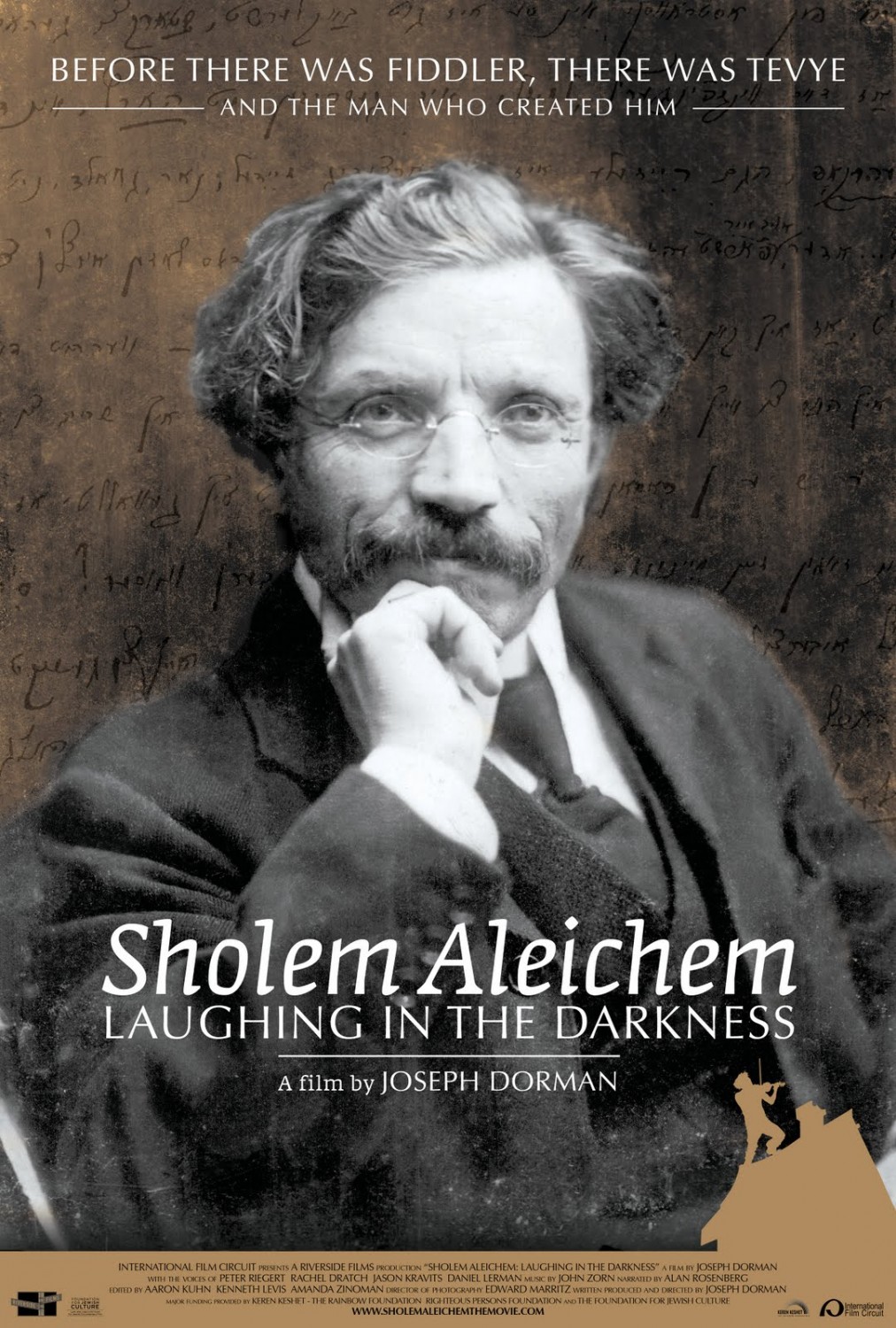
Sholem Aleichem: Laughing in the Darkness directed by Joseph Dorman 2011 (Documentary)
"The movie’s old photographs conjure the look and vitality of shtetl life so vividly you can almost feel yourself jostled in the crowded and dusty streets, hear the cries of peddlers and smell the pungent aromas of the cooking. The gnarly faces and hunched bodies of Jewish peasants, many dressed in rags, attest to decades of pain, hardship and stubborn endurance." from a review in the New York Times by Stephen Holden 7/11/2011
This interesting film traces the life and work of the great Yiddish writer Sholem Aleichem who was born Sholem Rabinowitz in 1859 in a shtetl in Ukraine and died in 1916 in New York City.
The strength of this film is its historical context. Sholem Aleichem lived at a time of much upheaval amongst Jewish communities throughout the Pale of Settlement. This upheaval affected his life and became the subject of his fiction. The Jews of the nineteenth century were mostly poor, insular, and religious. Laws promulgated by the czar and his government become more and more restrictive, and Russian peasants and local populations of Ukrainians were given license to perpetrate violence against the Jews. Pogroms become a threat and an actuality.
Also creating upheaval was industrialization which drove many of the children who had grown up in shtetls with their agrarian ways (thing Tevye, the milkman) to the cities where they were exposed to modernity. Many facets of this new way of life challenged the tenets of their early years. Such was the life of Sholem Aleichem who grew up in a religious family in Voronko and moved to Kiev where he was a successful writer of Yiddish tales who lived the sophisticated life of an intellectual. Like many others of his fellow Jews, he fled to America after a pogrom in 1905 seriously threatened his life and that of his family.
The film has terrific photos of life in the shtetls and in the cities, scenes of Jewish life at home, in religious school, Jews busy at work and relaxing in cafes. These photos of the elderly, married couples, school children, and babies, all of them dressed in their daily or religious or celebratory garb, bring to vivid life the world of our ancestors, a world that has vanished. The movie also includes interesting footage from Yiddish movies that recreate life in Eastern Europe.
Scholars interviewed supply the historical context. They talk about the flowering of the Yiddish language and culture. But they also talk about its demise. Despite being widely considered the beloved Jewish Mark Twain, Sholem Aleichem never hit his stride in America. Jewish strivers in America were looking forward to succeeding in the new country; they were less interested in looking back at scenes from the old country.
It is particularly interesting to hear Sholem Aleichem’s granddaughter Bel Kaufman, who is interviewed in the documentary, talk about some of what she remembers about her grandfather.
To read a recent article in the New York Time about some of the politics surrounding Yiddish click here.
To read a history of the shtetl click here.
People
Sholem Rabinowitz – married to Olga Loev
Bel Kaufman – granddaughter of Sholom Aleichem (exact connection not clear)
Scholars interviewed
Hillel Halkin
Aaron Lansky
Dan Miron
Avrom Nowerstern
David Roskeis
Ruth Wisse
Places
Voronko, Ukraine
Kiev, Ukraine
New York City, NY
This interesting film traces the life and work of the great Yiddish writer Sholem Aleichem who was born Sholem Rabinowitz in 1859 in a shtetl in Ukraine and died in 1916 in New York City.
The strength of this film is its historical context. Sholem Aleichem lived at a time of much upheaval amongst Jewish communities throughout the Pale of Settlement. This upheaval affected his life and became the subject of his fiction. The Jews of the nineteenth century were mostly poor, insular, and religious. Laws promulgated by the czar and his government become more and more restrictive, and Russian peasants and local populations of Ukrainians were given license to perpetrate violence against the Jews. Pogroms become a threat and an actuality.
Also creating upheaval was industrialization which drove many of the children who had grown up in shtetls with their agrarian ways (thing Tevye, the milkman) to the cities where they were exposed to modernity. Many facets of this new way of life challenged the tenets of their early years. Such was the life of Sholem Aleichem who grew up in a religious family in Voronko and moved to Kiev where he was a successful writer of Yiddish tales who lived the sophisticated life of an intellectual. Like many others of his fellow Jews, he fled to America after a pogrom in 1905 seriously threatened his life and that of his family.
The film has terrific photos of life in the shtetls and in the cities, scenes of Jewish life at home, in religious school, Jews busy at work and relaxing in cafes. These photos of the elderly, married couples, school children, and babies, all of them dressed in their daily or religious or celebratory garb, bring to vivid life the world of our ancestors, a world that has vanished. The movie also includes interesting footage from Yiddish movies that recreate life in Eastern Europe.
Scholars interviewed supply the historical context. They talk about the flowering of the Yiddish language and culture. But they also talk about its demise. Despite being widely considered the beloved Jewish Mark Twain, Sholem Aleichem never hit his stride in America. Jewish strivers in America were looking forward to succeeding in the new country; they were less interested in looking back at scenes from the old country.
It is particularly interesting to hear Sholem Aleichem’s granddaughter Bel Kaufman, who is interviewed in the documentary, talk about some of what she remembers about her grandfather.
To read a recent article in the New York Time about some of the politics surrounding Yiddish click here.
To read a history of the shtetl click here.
People
Sholem Rabinowitz – married to Olga Loev
Bel Kaufman – granddaughter of Sholom Aleichem (exact connection not clear)
Scholars interviewed
Hillel Halkin
Aaron Lansky
Dan Miron
Avrom Nowerstern
David Roskeis
Ruth Wisse
Places
Voronko, Ukraine
Kiev, Ukraine
New York City, NY
Monday, August 5, 2013
Stuffed: Adventures of a Restaurant Family by Patricia Volk 2001
“The mishpocheh that Volk celebrates here was connected to New York in all sorts of ways.” from a review by Daniel Mendelsohn in New York Magazine
The writer Patricia Volk has written an engaging memoir about her enterprising, sometimes eccentric, mostly endearing, large, extended immigrant family who lived and made their mark in New York City. The daughter of successful owners of a restaurant in New York City’s garment district, her parents “lived” at the restaurant, managing, hosting, keeping the books, and eating. She and her sister frequently joined them, and it is clear that the family business was a home-away-from-home.
Each chapter of the memoir, which is named after a particular food that has emotional resonance for the author, is a portrait of a relative who prepared or served it and who Volk recreates on the page in loving detail. These include great-grandparents, grandparents, aunts and uncles, all working to find their place in the New World as they continue to serve and enjoy foods of the Old Country, like chopped liver and sturgeon.
As a family they were amazingly successful. The author sketches in her early relatives’ savvy business moves. One restaurant spawned many others, each providing an opportunity for a family member to work hard and thrive. Jacob Volk, the author’s paternal grandfather, the family patriarch, became an entrepreneur and major presence in the commercial wrecking business. The author describes in vivid detail the homes in which these various relatives lived out their prosperous dreams. Many of them lived in large apartments on the Upper West Side of Manhattan (some in the same building) with maids who helped raise the children and helped cook and serve meals, often to four generations during holiday celebrations like Thanksgiving and Passover.
But despite their financial success, Volk describes how they followed a fairly typical immigrant pattern, complete with tension between the generations. Having arrived in this country as the children of religiously observant parents, they gradually assimilated. Some held on to the ways of the Old Country longer, but most abandoned strict religious observance and assumed the mantle of American culture. Like many others of their generation, the author’s family eventually moved to the suburbs and after giving up the restaurant, her parents retired to Florida.
The author includes many family photos as well as a family tree. At the end of the memoir she also includes a list of extracts from New York City Directories and New York City telephone books of members of her family that gives us a window into their upward mobility. The first entry is from 1897 of her maternal great-grandfather, Louis Lieban, whose business is recorded as “furs” and whose home address is on Delancey Street. In the 1940's Louis Lieban's son is a dentist, and family addresses are on West End Avenue, Riverside Drive, and Central Park West. The last entry, dated 2001, has names of family members the author has assembled to demonstrate how far away from New York some members of this family are now: Aside from Florida, they live as far away as Canada, Arizona, and Hawaii.
To read the New York Times obituary for Sussman (Cecil) Volk, father of the author, click here.
Family
Author’s mother’s family
Louis Leiban – married Jenny Geiger
(Elias) Al Leiban – son of Louis and Jenny; married Lillian Berger
Jerome Leiban – son of Louis and Jenny; married Helen
Leopold Leiban – son of Louis and Jenny
Gertrude Leiban – daughter of Louis and Jenny; married Dike Schultz
Wally – son of Gertrude
Ruth Leiban – daughter of Louis and Jenny; married Albert Wolko
Polly Leiban – daughter of Louis and Jenny; married Herman Morgen (see below)
Robert Morgen – son of Polly and Herman; married Barbara Krass
Joan Morgen – daughter of Robert and Barbara
Marcy Morgen Dulberg – daughter of Robert and Barbara
Audrey Morgen – daughter of Polly and Herman; married Sussman (Cecil) Volk
Jo Ann Volk – daughter of Audrey and Cecil; marries Alan Lederman
Elizabeth Lederman – daughter of Jo Ann and Alan
Daniel and Matthew Lederman – sons of Elizabeth
John Lederman – son of Jo Ann and Alan; married to Tonya
Michael Lederman – son of Jo Ann and Alan; married Kelly
Patricia Volk – daughter of Audrey and Cecil; author
Peter and Polly – children of Patricia
Lou and Fay Krass – parents of Barbara (see above)
Mark Morgenbesser – married Gertrude
Leopold Morgenbesser – son of Mark and Gertrude
Herman Morgen(besser) – son of Mark and Gertrude; married Polly Leiban (see above)
Julius Morgenbesser – son of Mark and Gertrude
Broncha Morgenbesser – daughter of Mark and Gertrude
Helen Morgenbesser – daughter of Mark and Gertrude
Leopold Morgenbesser – married Anna (a cousin - precise relationship to author’s immediate family not clear)
Hank Morgen(besser) – son of Leopold and Anna; married Hedy
Mundek Morgenbesser – son of Leopold and Anna
Josef Morgenbesser – son of Leopold and Anna
Brunek Morgenbesser – son of Leopold and Anna
Nella Morgenbesser – daughter of Leopold and Anna
Author’s father’s family
maternal side
Max Shure – married Anna
Frances Shure – daughter of Max and Anna
Alice Shure – daughter of Max and Anna
Lily Shure – daughter of Max and Anna
Rose Shure – daughter of Max and Anna
Eva Shure – daughter of Max and Anna
Ethel Edythe Shure – daughter of Max and Anna; married Jacob Volk (see below); 2nd husband – Charles Wolf
Helen Volk – daughter of Ethel and Jacob
Sussman (Cecil) Volk – son of Ethel and Jacob (see above)
Harriet Volk – daughter of Ethel and Jacob
paternal side
Albert Volk – brother of Sussman (see below)
Sussman Volk – brother of Albert; married to Sarah
Jacob Volk- son of Sussman and Sarah; married Ethel Edythe Shure (see above)
Ettie Volk – daughter of Sussman and Sarah, married to Nathan Stavin; 2nd husband ? Weiss
Cecil (Sussman), Maurice, and Steven Stavin – sons of Ettie and Nathan
Hannah Volk Fleschner – daughter of Sussman and Sarah
Cecil (Sussman) Fleschner – son of Hannah
Anna Volk Joseph – daughter of Sussman and Sarah Volk
Cecil (Sussman) Joseph – son of Anna
Albert Volk – son of Sussman and Sarah
Leonard Volk – son of Sussman and Sarah
Friends and Acquaintances
Robert Shapera (Evans) – Ali McGraw
Alice Shapera – sister of Robert
Places
Nowy Targ, Poland
Vilnius, Lithuania
New York City, NY
Boca Raton, Florida
Kings Point, NY
Labels:
Book review of Volk's Stuffed,
Jewish immigrants,
Jews of America,
Jews of Florida,
Jews of New York City
Monday, July 15, 2013
The Watchmaker's Daughter by Sonia Taitz
"Though the author focuses mostly on her experiences, it is Simon and Gita’s perseverance that truly shines—the former a respected watchmaker who began life anew more than once, the latter a concert-level pianist whose dreams were thwarted by war and who rescued her own mother from the Nazis' infamous selections." from a review in Kirkus Review 7/30/2012
Sonia Taitz, the daughter of two Lithuanian Jewish Holocaust survivors, has written an engaging memoir that gets at the essence of what was for her, the challenge of growing up the daughter of survivors whose grief and refugee status defined who they were.
In many ways Taitz’s story is not different from many other memoirs written by the children of survivors. But her ability to animate for us her relationship to her parents and to describe her parents so that we feel we know them allows us to get a clear and vivid picture of their family life which, though universal in its oultine, is specific in its detail.
Much of Taitz’s story focuses on the relationship she had with each of her parents. Her father, an accomplished watchmaker whose skills helped him survive Dachau, admired her independent spirit and her academic abilities and he pushed her to succeed. Her mother, an accomplished pianist whose potential career was destroyed by the Holocaust, struggled with her rebellious daughter whose personality and interests she often did not understand.
The young Sonia felt very different from the children who were growing up alongside her in post-World War II America, and she was embarrassed by her circumstances. Her parents spoke Yiddish at home and lived in a two-bedroom apartment in Washington Heights in upper Manhattan where her brother slept in the living room. Her mother wore floral housedresses, shopped for bargain merchandise and cooked the foods she knew from Europe. When it came time for the author to go to college her parents insisted she stay close to home and go to Barnard, not to Radcliffe where she had also been accepted.
The end of the memoir deals with the death of each of her parents. At this point the author is a mother of three children and as an adult has come to terms with how the Holocaust had shaped their lives. She has come to understand them in ways she couldn’t possibly when she was a child, teenager and young adult, trying to establish her own identity, free of their burdens. Now, more than ever, she has become their parents - taking care of them, trying to hold on to them as they each succumb to cancer, despairing that after the early experiences they had suffered through, they each had to suffer so horribly again.
To read an article about the effects of Holocaust trauma on subsequent generations click here.
To read an article about the psychological profile of Holocaust survivors click here.
People
Father’s family
Sonia Taitz
Aaron Taitz - son of Sonia
PaulaTaitz - daughter of Sonia
Simon Taitz – son of Sonia; married Gita Wery-Bey
Emmanuel Taitz – son of Simon and Gita
Jennifer and Michelle Taitz – daughters of Emmanuel
Sonia Taitz – son of Simon and Gita; married Paul; author
Emma, Gabriel, Phoebe – children on Paul and Sonia
Mother’s family
Menachem Mendel Wery-Bey- married Liba Davidow
Gita – daughter of Menachem Mendel and Liba; married Simon Taitz (see above)
David Wery-Bey – brother of Menachem Mendel
Places
Kaunas, Lithuania
New York City, NY
Washington Heights, NY
Stutthof Concentration Camp, Poland
Dachau Concentration Camp, Germany
Sonia Taitz, the daughter of two Lithuanian Jewish Holocaust survivors, has written an engaging memoir that gets at the essence of what was for her, the challenge of growing up the daughter of survivors whose grief and refugee status defined who they were.
In many ways Taitz’s story is not different from many other memoirs written by the children of survivors. But her ability to animate for us her relationship to her parents and to describe her parents so that we feel we know them allows us to get a clear and vivid picture of their family life which, though universal in its oultine, is specific in its detail.
Much of Taitz’s story focuses on the relationship she had with each of her parents. Her father, an accomplished watchmaker whose skills helped him survive Dachau, admired her independent spirit and her academic abilities and he pushed her to succeed. Her mother, an accomplished pianist whose potential career was destroyed by the Holocaust, struggled with her rebellious daughter whose personality and interests she often did not understand.
The young Sonia felt very different from the children who were growing up alongside her in post-World War II America, and she was embarrassed by her circumstances. Her parents spoke Yiddish at home and lived in a two-bedroom apartment in Washington Heights in upper Manhattan where her brother slept in the living room. Her mother wore floral housedresses, shopped for bargain merchandise and cooked the foods she knew from Europe. When it came time for the author to go to college her parents insisted she stay close to home and go to Barnard, not to Radcliffe where she had also been accepted.
The end of the memoir deals with the death of each of her parents. At this point the author is a mother of three children and as an adult has come to terms with how the Holocaust had shaped their lives. She has come to understand them in ways she couldn’t possibly when she was a child, teenager and young adult, trying to establish her own identity, free of their burdens. Now, more than ever, she has become their parents - taking care of them, trying to hold on to them as they each succumb to cancer, despairing that after the early experiences they had suffered through, they each had to suffer so horribly again.
To read an article about the effects of Holocaust trauma on subsequent generations click here.
To read an article about the psychological profile of Holocaust survivors click here.
People
Father’s family
Sonia Taitz
Aaron Taitz - son of Sonia
PaulaTaitz - daughter of Sonia
Simon Taitz – son of Sonia; married Gita Wery-Bey
Emmanuel Taitz – son of Simon and Gita
Jennifer and Michelle Taitz – daughters of Emmanuel
Sonia Taitz – son of Simon and Gita; married Paul; author
Emma, Gabriel, Phoebe – children on Paul and Sonia
Mother’s family
Menachem Mendel Wery-Bey- married Liba Davidow
Gita – daughter of Menachem Mendel and Liba; married Simon Taitz (see above)
David Wery-Bey – brother of Menachem Mendel
Places
Kaunas, Lithuania
New York City, NY
Washington Heights, NY
Stutthof Concentration Camp, Poland
Dachau Concentration Camp, Germany
Monday, July 1, 2013
Helga’s Diary: A Young Girl’s Account of Life in a Concentration Camp by Helga Weiss
Helga Weiss, who was born in 1929 in Prague, Czechoslovakia, survived to see the journal she kept during and after World War II published in 2013. Her story is similar to others who were moved from camp to camp, each time not knowing where they were going and what their fate would be when they arrived.
As a young child she was deported with her parents to Terezin (Theresienstadt) where she spent most of her imprisonment. From there she was moved to Auschwitz, then to Frieberg, a satellite work camp connected to the Flossenburg concentration camp. When it didn’t seem like their situation could get much worse, it got even worse. She and her mother barely survived a sixteen-day trip to the Mauthausen concentration camp where they were finally liberated.
One of the most moving pieces of this memoir is the family dynamic. The author, an only child, was separated from her father early because once in Terezin males and females were sent to separate living quarters. But she did manage to see him during the day. Her father got work in the financial office and had power to delay the deportation of family members – many of their relatives ended up in Terezin. But eventually they are all deported. There is much agony: Should she and her mother insist on going on the same transport he is assigned to? He insists not. Mother and daughter are deported the day after he is, and Helga hopes against hope that she will see her father when she arrives wherever they are being sent.
It is only in hindsight that the author comes to realize that incarceration in Terezin was bearable compared to what happened once they were deported. Her descriptions of Terezin encompass both the good and the bad. The closeness that developed amongst her and other teenagers, their birthday celebrations and parties are contrasted to the overcrowded conditions, the serious outbreaks of diseases like typhus, the annoyance of bedbugs and lice, the constant worry about being selected for a transport. Once they are on a transport, as they move from place to place, food supplies dwindle; in the weeks before the Germans surrender there is barely any food. Helga’s mother becomes so weak that Helga, still a young teenager, has the added burden of making sure her mother survives.
Helga Weiss and her mother had been imprisoned for three and a half years. The author was released when she was 15 ½, one of a small number of children from Terezin to have survived.
This edition of the memoir includes:
A map of Helga’s journey
A map of Terezin
An Introduction - Francine Prose places this memoir in the context of other Holocaust memoirs.
An Author’s Note – Helga Weiss writes about the writing and re-writing of this memoir
An Interview with Helga Weiss – the author answers questions posed by the translator Neil Bermel about her experience during the war and about the writing of her journal.
A Translator’s Note – Neil Bermel writes about Helga Weiss’s writing style and how he worked with the mix of the German and Czech languages.
A Glossary of German terms not translated into English
To watch an interview with Helga Weiss which also includes photos and some of her artwork representing scenes during her imprisonment, click here.
To read a previous post of a review of a cookbook assembled by women in Theriesenstadt, click here.
To read a post on this blog about a memoir written by Gonda Redlich, also a prisoner in Theresienstadt, click here.
To read a post on this blog of a memoir written by Petr Ginz, also a prisoner in Theresienstadt, click here.
To read a post on this blog about Madeleine Albright's memoir Prague Winter which has several chapters on Theresienstadt, click here.
To read a post on this blog about a book that takes place in Terezin called "The Girls of Room 28," click here.
People
Sofie Weiss
Otto Weiss – son of Sophie; married to Irena Fuchsova
Helga Weiss – daughter of Otto and Irena
Dominika, Natalie, and Sarah – granddaughters of Helga
Josef Polak – uncle of Helga; exact relationship unclear
Friends and Acquaintances
Eva Vohryzeks
Fredy Hirsch
Laska and Ruza Vogelova
Jakob Edelstein
Places
Prague, Czechoslovakia (now the Czech Republic)
Terezin concentration camp, Czechoslovakia
Auschwitz concentration camp, Poland
Frieburg, Germany
Mauthausen concentration camp, Austria
Monday, June 17, 2013
Who She Was: My Search for My Mother’s Life, by Samuel Freedman 2005
"A son’s story, a Jewish story, an American story." from a review in Kirkus Reviews
The journalist Samuel Freedman (b. 1955) lost his mother to breast cancer when she was 50 during his sophomore year of college. He felt he never knew her very well, preoccupied as he was, first with his life as a teenager, then as a college student in Wisconsin, quite a distance from his home in New Jersey. He decided to do the research and write this memoir in an attempt to better understand her, by conducting extensive interviews with friends and family and by investigating other sources like letters, diaries, photos, and newspapers.
Through his research he recreates the Bronx of his mother’s youth, early adulthood, and young married life. He explores her home life, her Morris High School experiences, her work life and her social life. His skills as a journalist help him to place her life in historical context. He fleshes out the Jewish immigrant experience in the Bronx with the attendant tension between the immigrant parents and their American children. And he explores the social and economic impact of the Depression, World War II, and the post-war preoccupation with Communists in America. He also discusses what the cultural expectations were for a woman in his mother’s time and how those often unspoken restrictions played out in her life.
One of the most significant threads Freedman explores is the antagonistic relationship that existed between his mother and her mother which stemmed mostly from his grandmother’s insistence on the importance of living a traditional Jewish life. The author’s mother, a very bright student, spent much of her energy in rebellion. It is not surprising that the author, having delved as deeply as he could into their relationship and the circumstances surrounding it, develops a more nuanced understanding of both his mother and his grandmother.
But finally the author realizes that, despite having done a yeoman's job of recreating the past and having learned a great deal about his mother, he can never really know her completely. The fuller picture can never bring her to life, it can never completely fill the emotional gap created by her early death and his early loss.
To read an excerpt from this memoir, click here.
To read an article about the history of Jews in the Bronx, click here.
People
Author's mother's father's family
Sarah Hatkin
Samuel Hatkin – son of Sarah
Sol Hatkin – son of Sarah; married Rachel (Rose) Markiewicz
Eleanor Hatkin – daughter of Sol and Rose; married Leonard Benjamin Schulman; second marriage to David Freedman
Samuel Freedman - son of Eleanor and David; married Cynthia Sheps
Aaron and Sarah Freedman - children of Samuel and Cynthia
Fannie Hatkin – daughter of Sol and Rose; married Danny Schlomkowitz (Stevens)
Joel Schlomkowitz (Stevens) – son of Danny and Fannie
Seymour Hatkin – son of Sol and Rose; married Evelyn
Jacob Hatkin – son of Sarah; married Rachel Gartenberg, cousin of Rachel Markiewicz
David Hatkin – son of Sarah
Mildred Schlomkowitz – sister to Danny (see above)
Jack and Hilda Schulman
Leonard Schulman - son of Jack and Hilda (see above)
Alan Schulman – son of Jack and Hilda
Leonard Hatkin – cousin of Eleanor; exact relationship unclear; married Thelma
Harry Schneer – cousin of Sol Hatkin; relationship unclear
Elaine Sheps - mother of Cynthia (see above)
Author's mother's mother's family
Yehuda Ariyeh Markiewicz – father of Rachel Markiewicz
Rachel (Rose) Markiewicz – daughter of Yehuda Ariyeh; married Sol Hatkin (see above)
Ester Dina Markiewicz – daughter of Yehuda Ariyeh; married Alter David Kaczkowicz
Judis Kaczkowicz – daughter of Esther Dina and Alter David; married Jaime Prusky
Julius Kaczkowicz– son of Ester Dina and Alter David; married Rebeca Kaganas
Menuchi Markiewicz – daughter of Yehuda Ariyeh
Avram Markiewicz – son of Yehuda Ariyeh
Shifra Markiewicz – daughter of Yehuda Ariyeh
Shai Gartenberg – uncle of Rose Markiewicz – exact relationship not clear
Minnie and Morris Osder – Minnie is a cousin of Rose Markiewicz – exact relationship unclear
Rebeca and Guillermo Bronstein - relatives in Uruguay - exact relationship unclear
Dina Berlinblau - relative in Uruguay - exact relationship unclear
Pinhas Kaczkowicz – cousin of David Kaczkowicz (married to Ester Dina Markiewicz – see above)
Author's father's family
Samuel and Rose Freedman
Ziggy Freedman – son of Samuel and Rose
Clara Freedman – daughter of Samuel and Rose
David Freedman – son of Samuel and Rose; married Eleanor Hatkin Schulman (see above)
Friends and Acquaintances
Regina and Monikou Adler – sisters
Clare Abramowitz – married Hy Dickman
Leon Becker
Vicky Behar – married Dave Fried
Artie Bernfeld
Ralph Betstadt – married Lillian Golden
Miriam Beyman
Shirley Binenstock
Bruno (Bernie) Brenner – brother of Ignaz
Ignaz (Irving) Brenner – brother of Bruno; married Fannie Povodator
Florence Brodsky
Harry Ceitlin
Maxwell Cohen
Sid Cozin
Bern Dibner
Bernie Dunetz – married Anita Rosenhoch
Sandy Dunetz – child of Bernie and Anita
Stanley Feldman – brother-in-law of Herman Keltz
Jerry Ferber
Bea Flesichman
Artie Fluger
Stanley Frank
Rudy Friedlander
Lou and Murray Glass – brothers; cousins of Vicky Behar
Al Glazer
Sol and Sidney Goldfarb – brothers
Mel Goodman
Howard Gropper
Dick Gumerov
Florence Herzog
Marion Herzog – daughter of Florence; married Saul Maidens
Max Kagan
Herman David Keltz
Mildred Keltz – sister of Herman
Rose Klekman
Hy Kraft
Abe Kronenfeld
Ruth Liebowitz
Morris Laitman
Joe Lempert
Leon Mandelbaum
Ted Millon
Bernie Murowitz
Harriss Pacter
Bernard Pacter – son of Harriss
Noach Pacter – brother to Harriss; married to Fannie
Sam Pacter – son of Noach and Fannie
Ruth Pacter – daughter of Noach and Fannie; married Al Taylor
Estelle Pacter – daughter of Noach and Fannie
Simmy Plansky
Buddy Rashbaum
Neil Rosenberg
Bill Rosenhoch – sister of Anita; married Naomi Gruder
Pauline Rubenstein
Selma Rubenstein – daughter of Pauline
Hilda Saltzman Wachtenheim
George Slayton – cousin of Claire Abromowitz
Bernie Solomon
Jack Steinglass
Flo Zipkin
Places
Kolno, Poland
Bialystok, Poland
Morrisania, The Bronx, New York
Morris High School, The Bronx, New York
Brownsville, Brooklyn, New York
Montevideo, Uruguay
Stelton, New Jersey
Highland Park, New Jersey
The journalist Samuel Freedman (b. 1955) lost his mother to breast cancer when she was 50 during his sophomore year of college. He felt he never knew her very well, preoccupied as he was, first with his life as a teenager, then as a college student in Wisconsin, quite a distance from his home in New Jersey. He decided to do the research and write this memoir in an attempt to better understand her, by conducting extensive interviews with friends and family and by investigating other sources like letters, diaries, photos, and newspapers.
Through his research he recreates the Bronx of his mother’s youth, early adulthood, and young married life. He explores her home life, her Morris High School experiences, her work life and her social life. His skills as a journalist help him to place her life in historical context. He fleshes out the Jewish immigrant experience in the Bronx with the attendant tension between the immigrant parents and their American children. And he explores the social and economic impact of the Depression, World War II, and the post-war preoccupation with Communists in America. He also discusses what the cultural expectations were for a woman in his mother’s time and how those often unspoken restrictions played out in her life.
One of the most significant threads Freedman explores is the antagonistic relationship that existed between his mother and her mother which stemmed mostly from his grandmother’s insistence on the importance of living a traditional Jewish life. The author’s mother, a very bright student, spent much of her energy in rebellion. It is not surprising that the author, having delved as deeply as he could into their relationship and the circumstances surrounding it, develops a more nuanced understanding of both his mother and his grandmother.
But finally the author realizes that, despite having done a yeoman's job of recreating the past and having learned a great deal about his mother, he can never really know her completely. The fuller picture can never bring her to life, it can never completely fill the emotional gap created by her early death and his early loss.
To read an excerpt from this memoir, click here.
To read an article about the history of Jews in the Bronx, click here.
People
Author's mother's father's family
Sarah Hatkin
Samuel Hatkin – son of Sarah
Sol Hatkin – son of Sarah; married Rachel (Rose) Markiewicz
Eleanor Hatkin – daughter of Sol and Rose; married Leonard Benjamin Schulman; second marriage to David Freedman
Samuel Freedman - son of Eleanor and David; married Cynthia Sheps
Aaron and Sarah Freedman - children of Samuel and Cynthia
Fannie Hatkin – daughter of Sol and Rose; married Danny Schlomkowitz (Stevens)
Joel Schlomkowitz (Stevens) – son of Danny and Fannie
Seymour Hatkin – son of Sol and Rose; married Evelyn
Jacob Hatkin – son of Sarah; married Rachel Gartenberg, cousin of Rachel Markiewicz
David Hatkin – son of Sarah
Mildred Schlomkowitz – sister to Danny (see above)
Jack and Hilda Schulman
Leonard Schulman - son of Jack and Hilda (see above)
Alan Schulman – son of Jack and Hilda
Leonard Hatkin – cousin of Eleanor; exact relationship unclear; married Thelma
Harry Schneer – cousin of Sol Hatkin; relationship unclear
Elaine Sheps - mother of Cynthia (see above)
Author's mother's mother's family
Yehuda Ariyeh Markiewicz – father of Rachel Markiewicz
Rachel (Rose) Markiewicz – daughter of Yehuda Ariyeh; married Sol Hatkin (see above)
Ester Dina Markiewicz – daughter of Yehuda Ariyeh; married Alter David Kaczkowicz
Judis Kaczkowicz – daughter of Esther Dina and Alter David; married Jaime Prusky
Julius Kaczkowicz– son of Ester Dina and Alter David; married Rebeca Kaganas
Menuchi Markiewicz – daughter of Yehuda Ariyeh
Avram Markiewicz – son of Yehuda Ariyeh
Shifra Markiewicz – daughter of Yehuda Ariyeh
Shai Gartenberg – uncle of Rose Markiewicz – exact relationship not clear
Minnie and Morris Osder – Minnie is a cousin of Rose Markiewicz – exact relationship unclear
Rebeca and Guillermo Bronstein - relatives in Uruguay - exact relationship unclear
Dina Berlinblau - relative in Uruguay - exact relationship unclear
Pinhas Kaczkowicz – cousin of David Kaczkowicz (married to Ester Dina Markiewicz – see above)
Author's father's family
Samuel and Rose Freedman
Ziggy Freedman – son of Samuel and Rose
Clara Freedman – daughter of Samuel and Rose
David Freedman – son of Samuel and Rose; married Eleanor Hatkin Schulman (see above)
Friends and Acquaintances
Regina and Monikou Adler – sisters
Clare Abramowitz – married Hy Dickman
Leon Becker
Vicky Behar – married Dave Fried
Artie Bernfeld
Ralph Betstadt – married Lillian Golden
Miriam Beyman
Shirley Binenstock
Bruno (Bernie) Brenner – brother of Ignaz
Ignaz (Irving) Brenner – brother of Bruno; married Fannie Povodator
Florence Brodsky
Harry Ceitlin
Maxwell Cohen
Sid Cozin
Bern Dibner
Bernie Dunetz – married Anita Rosenhoch
Sandy Dunetz – child of Bernie and Anita
Stanley Feldman – brother-in-law of Herman Keltz
Jerry Ferber
Bea Flesichman
Artie Fluger
Stanley Frank
Rudy Friedlander
Lou and Murray Glass – brothers; cousins of Vicky Behar
Al Glazer
Sol and Sidney Goldfarb – brothers
Mel Goodman
Howard Gropper
Dick Gumerov
Florence Herzog
Marion Herzog – daughter of Florence; married Saul Maidens
Max Kagan
Herman David Keltz
Mildred Keltz – sister of Herman
Rose Klekman
Hy Kraft
Abe Kronenfeld
Ruth Liebowitz
Morris Laitman
Joe Lempert
Leon Mandelbaum
Ted Millon
Bernie Murowitz
Harriss Pacter
Bernard Pacter – son of Harriss
Noach Pacter – brother to Harriss; married to Fannie
Sam Pacter – son of Noach and Fannie
Ruth Pacter – daughter of Noach and Fannie; married Al Taylor
Estelle Pacter – daughter of Noach and Fannie
Simmy Plansky
Buddy Rashbaum
Neil Rosenberg
Bill Rosenhoch – sister of Anita; married Naomi Gruder
Pauline Rubenstein
Selma Rubenstein – daughter of Pauline
Hilda Saltzman Wachtenheim
George Slayton – cousin of Claire Abromowitz
Bernie Solomon
Jack Steinglass
Flo Zipkin
Places
Kolno, Poland
Bialystok, Poland
Morrisania, The Bronx, New York
Morris High School, The Bronx, New York
Brownsville, Brooklyn, New York
Montevideo, Uruguay
Stelton, New Jersey
Highland Park, New Jersey
Labels:
Bialyostock,
Book review of Freedman's Who She Was,
Holocaust - survivor,
Holocaust - descendants of survivors,
Jewish immigrants,
Jews of New York,
Jews of Poland,
Jews of the Bronx
Monday, June 3, 2013
Red Brick, Black Mountain, White Clay: Reflections on Art, Family and Survival by Chrisopher Benfey, 2012
"The later pages of the book’s first section trace the Jewish thread of family history; the meditative aspect of Benfey’s journey sends off 'if only' reverberations, suggestions of identity compromised and spiritual treasure lost." from a review by Philip K. Jason posted on the blog of the Jewish Book CouncilThis memoir has a global reach. The author, a professor of English literature, a writer and a critic, is the son of a father who was a German Jewish refugee who was born in Berlin and a Quaker mother born in America.
The author’s father, O. Theodor Benfey, the son of a prominent judge, married Lotte Fleischmann, a daughter in the Ullstein family, the founders of a large European publishing house. Both sides of the author’s assimilated German Jewish family converted to Lutheranism. They felt that they were German to the core, but they soon learned that Hitler felt otherwise. In 1933 the Nazis seized the Ullstein family’s publishing company. Fearing for their ten-year-old son's future, in 1936 Otto Theodor’s parents sent him to England to live with family friends.
Several years later O. Theodor Benfey's parents also fled to England and then to the U.S. where Lotte’s sister Anni, a textile artist married to the artist Josef Albers, had already fled. They had left after the Nazis closed the Bauhaus in Berlin where Anni and Josef Albers had worked.
Tracing his father’s family involved actual and virtual travel to Germany, England, and Mexico. Although this memoir spends more time on his mother’s Quaker roots than his father’s German-Jewish roots, the chapters dedicated to his father and his family are quite interesting. Especially engrossing is the investigation into the Jewish origins of the Benfey name.
To read an article about anti-Jewish legislation in pre-war Germany, click here.
Family
Author’s father’s paternal family
Eduard Benfey – married to Lotte Fleischmann
Renate Benfey Wilkins – daughter of Eduard and Lotte
Otto Theodor Benfey – son of Eduard and Lotte; married to Rachel Thomas
Stephen Benfey – son of Otto Theodor and Rachel
Christoper Benfey – son of Otto Theodor and Rachel; married to Mickey Rathbun; author
Tommy and Nicholas Benfey – sons of Christopher
Philip Benfey – son of Otto Theodor and Rachel
Karen Benfey Boyd – daughter of Otto Theodor and Rachel
Arnold Benfey - brother of Eduard
Ernst Benfey - brother of Eduard
Feistel Dotteres (Philipp Theodorus) - early Benfey ancestor
Isaak Philipp Benfey - son of Feistel
Simline Benfey – daughter of Isaak
Theodor Benfey – son of Isaak; author’s father’s great-granduncle
Meta Benfey – daughter of Theodor
Philip Benfey – son of Isaak
Bruno Benfey – relative; connection unclear
Author’s father’s maternal family
Siegfried Fleischmann – married Toni Ullstein
Anni Fleischmann – married Josef Albers
Lotte Fleischmann – daughter of Siegfried and Toni; married Eduard Benfey (see above)
Hanz, Louis, Franz, Rudolf, and Hermann Ullstein – brothers of Toni (see above)
Acquaintances
Walter Benjamin
Heinrich Heine
Gerald and Babs Mendl
Wolfgang Mendl – son of Gerald and Babs
Karen Karnes – married David Weinrib – Jo Anne (his second wife)
Places
Richmond, Indiana
Greensboro, North Carolina
Cambridge, Massachusetts
Berlin, Germany
Watford, England
Black Mountain College, North Carolina
Richmond, Indiana
Labels:
Book review of Benfey's Red Brick Black Mountain White Clay,
Holocaust - descendants of survivors,
Holocaust - survivors,
Jews of America,
Jews of Berlin,
Jews of Germany,
Jews of North Carolina
Monday, May 20, 2013
Europa, Europa by Solomon Perel, published in English in 1997
"Perel's continuing struggle with identity was indirectly reflected in the various titles of his memoirs, which have been published in French, German and ... Hebrew." from an article written by Daniel Williams in the Los Angeles Times 3/30/92
Solomon Perel, born in Germany in 1925 to a Russian-Jewish family who settled in Pleine, Germany after the Russian revolution, has a powerful story to tell about his experience masquerading as a young German, hiding in their very midst. In 1935 when he was ten, his family fled to Lodz in Poland, expecting that they would be safer there than in Hitler’s Germany. The author, a very good student, learned Polish quickly and settled into life in Poland only to be uprooted again when Hitler invaded Poland in September of 1939.
His parents, fearing for the safety of their children, urged Solomon to cross the border into the Soviet Union with his brother Isaac. The two brothers soon become separated and here begins a tale that reveals the deep determination of the author to survive. He tells his tale in order to describe the incredible stress he endured and to dramatize his responses to events that threatened his survival. He is not trying to portray himself as heroic. He is trying to plumb the depths of his psyche and explain as best he can to himself and to his readers how he could assume a German identity complete with a name and a background he invented and maintain it until the war was over. He became two separate people – Solly inside, and Jupp on the outside.
His fears were many. For example, he did not have papers identifying him as German (he told the Germans they were destroyed in a bombing), he had to keep his background story straight every time he told it, he was afraid he’d be identified as being a Jew if someone saw that he was circumcised, and he had to learn not to react “inappropriately” when being subjected to Nazi propaganda which was a constant condition of his life.
But he was smart and he was lucky. The fact that he was alone and spoke German made it possible to pose as a non-Jewish orphaned German. He put his ability to speak Russian to good use by acting as a translator for the Germans as they interviewed wounded Russian soldiers. Because his intelligence impressed the Nazis, tthey sent him to Germany where he was enrolled in an elite Hitler Youth school where he was fed, clothed and safe. And his feigned enthusiasm also helped in his interactions with various Germans and Nazi officials.
When the war was over and he was on his own again, having inhabited the psyche for three years of a young German being groomed for an elite position in the Nazi power structure, it was difficult for him to feel free and to tell anyone that he was a Jew. When he finally felt liberated enough to live outwardly as a Jew, having seen and heard about the suffering of concentration camp survivors, it was then difficult for him to claim to be a survivor.
To see the trailer for the award-winning movie made based on Perel's memoir, click here.
To read an interview with the author in the New York Times, click here.
People
Eliahu bar Halperin – grandfather of author;
Rebecca – daughter of Eliahu; married Azriel Perel
Isaac Perel –son of Rebecca and Azriel; married Mira Rabinowitz
Naomi Perel – daughter of Isaac and Mira
David Perel – son of Rebecca and Azriel; married Pola Rosner
Azriel Perel – son of David and Pola
Bertha Perel – son of Rebecca and Azriel
Solomon Perel – son of Rebecca and Azriel; author
Clara Wachsmann - daughter of Eliahu
Friends and Acquaintances
Jerzyk Rappoport
Jakob Lublinski
Hans Marburger
Binem Koppelmann
Manfred Frenkel
Lotte Friedenthal
Eliahu Beth Josef
Places
Peine, Germany
Lodz, Poland
Smorgon, Lithuania?
Stutthof Concentration Camp, Poland
Munich, Germany
Tel Aviv, Israel
Solomon Perel, born in Germany in 1925 to a Russian-Jewish family who settled in Pleine, Germany after the Russian revolution, has a powerful story to tell about his experience masquerading as a young German, hiding in their very midst. In 1935 when he was ten, his family fled to Lodz in Poland, expecting that they would be safer there than in Hitler’s Germany. The author, a very good student, learned Polish quickly and settled into life in Poland only to be uprooted again when Hitler invaded Poland in September of 1939.
His parents, fearing for the safety of their children, urged Solomon to cross the border into the Soviet Union with his brother Isaac. The two brothers soon become separated and here begins a tale that reveals the deep determination of the author to survive. He tells his tale in order to describe the incredible stress he endured and to dramatize his responses to events that threatened his survival. He is not trying to portray himself as heroic. He is trying to plumb the depths of his psyche and explain as best he can to himself and to his readers how he could assume a German identity complete with a name and a background he invented and maintain it until the war was over. He became two separate people – Solly inside, and Jupp on the outside.
His fears were many. For example, he did not have papers identifying him as German (he told the Germans they were destroyed in a bombing), he had to keep his background story straight every time he told it, he was afraid he’d be identified as being a Jew if someone saw that he was circumcised, and he had to learn not to react “inappropriately” when being subjected to Nazi propaganda which was a constant condition of his life.
But he was smart and he was lucky. The fact that he was alone and spoke German made it possible to pose as a non-Jewish orphaned German. He put his ability to speak Russian to good use by acting as a translator for the Germans as they interviewed wounded Russian soldiers. Because his intelligence impressed the Nazis, tthey sent him to Germany where he was enrolled in an elite Hitler Youth school where he was fed, clothed and safe. And his feigned enthusiasm also helped in his interactions with various Germans and Nazi officials.
When the war was over and he was on his own again, having inhabited the psyche for three years of a young German being groomed for an elite position in the Nazi power structure, it was difficult for him to feel free and to tell anyone that he was a Jew. When he finally felt liberated enough to live outwardly as a Jew, having seen and heard about the suffering of concentration camp survivors, it was then difficult for him to claim to be a survivor.
To see the trailer for the award-winning movie made based on Perel's memoir, click here.
To read an interview with the author in the New York Times, click here.
People
Eliahu bar Halperin – grandfather of author;
Rebecca – daughter of Eliahu; married Azriel Perel
Isaac Perel –son of Rebecca and Azriel; married Mira Rabinowitz
Naomi Perel – daughter of Isaac and Mira
David Perel – son of Rebecca and Azriel; married Pola Rosner
Azriel Perel – son of David and Pola
Bertha Perel – son of Rebecca and Azriel
Solomon Perel – son of Rebecca and Azriel; author
Clara Wachsmann - daughter of Eliahu
Friends and Acquaintances
Jerzyk Rappoport
Jakob Lublinski
Hans Marburger
Binem Koppelmann
Manfred Frenkel
Lotte Friedenthal
Eliahu Beth Josef
Places
Peine, Germany
Lodz, Poland
Smorgon, Lithuania?
Stutthof Concentration Camp, Poland
Munich, Germany
Tel Aviv, Israel
Subscribe to:
Posts (Atom)


EE9s2ugOeKBRnNdN4mYQ~~60_12.jpg)